Blogging Nick Piggott

Nick Piggott's blog about the intersection between new media and radio

Nokia, Microsoft… and Radio? 11/02/2011

Filed under: dab digital radio,mobile,radio,technology — Nick Piggott @ 23:09

There’s plenty being written about Nokia’s decision to adopt Windows Phone 7 as the operating system for their handsets, consigning Symbian to history, and apparently moving Maemo / Meego to the back burner.

Radio has been a function on Nokia handsets for many years, and one of the unofficial benchmarks to measure DAB’s progress has been “when Nokia put DAB in their phones“.

It is then somewhat ironic that Nokia’s DAB Adaptor seems to be getting a warm reception, even though it’s shackled to a phone that appears to typify the dead-end Nokia find themselves in. (If ever there was a demonstration of the gulf between Nokia’s skills as a hardware maker and their ineptitude at writing software, the N8 running Symbian^3 is it).

So is Nokia’s “capitulation” to Microsoft a blow to the vision of getting radio into all mobile phones?

I don’t think so. This turmoil provides opportunities for the radio industry, but only if we’re smart enough to expose and nurture them.

The foundations are good. Nokia make good hardware, and radio is a function of the hardware. Whilst FM Radio reception is theoretically a function of most Bluetooth baseband stacks, making an FM Radio that works in a phone involves some skill with antennae. On that assessment, Nokia seem to do better with their antennae than some popular handset manufacturers.

It’s true that Symbian has had APIs to control FM Radio functionality for a long time, but people will tell you that the implementation is typically Symbian – inconsistent, over-complex and insufficiently reliable.

Windows Phone 7 is already surprisingly radio friendly, not least because of its lineage (or at least sibling relationship to) the Zune platform. FM Radio is implemented in all current Windows Phone 7 handsets, and the hardware seems to be good. The current APIs are naive, but that can be fixed if the radio industry explains clearly to Microsoft what it needs, and why its a good thing.

What about Nokia’s DAB Adaptor, now helplessly dragged down by a phone and platform that’s been life expired after just a few months? Frustratingly, this is simply one of the most sensitive DAB receivers I’ve ever used, and it would be ridiculous to lose that excellent engineering. The adaptor uses USB functionality, but requires a USB Host device, something virtually no mobile phone supports. But that could be changed at minimal engineering cost, and the adaptor rolled to plenty of other handsets and platforms.

Message to Nokia – don’t kill the DAB Adaptor. It’s very good. Keep it on your roadmap. Adjust it to work with Windows Phone 7. And Meego (of which more later).

The really big opportunity for radio is to present radio functionality as a strong product differentiator against Apple and Android. Apple seem to be right off radio and Android has such a fragmented approach to hardware design it will be hard to make radio a consistent  function. Microsoft/Nokia are now challengers, and challengers take risks and do things that the leaders find less easy to do.

If the radio industry wants radio to be a baseline feature of all mobile phones, it’s time to work hard with a challenger, and give up  chasing Apple like forlorn lovestruck teens. It’s time to talk about:

  • Consistent APIs that work across analogue and digital radio (in all its forms)
  • Firmware support for hybrid radio functionality
  • Receivers that are sensitive and low-power
  • Creating an environment where any developer can write an app that exploits radio functionality, and making it cool to do so
  • Agreeing business models that increase the value of radio to all parties – consumers, manufacturers, network operators and broadcasters.

It would be foolish to write Nokia/Microsoft off. They have scale and experience, and determination. Now seems to be a good time to get in at the ground floor.

A P.S. on Meego.

Full disclosure. My main phone is a Nokia N900 running Maemo, and I find it excellent. I see Meego with the potential to be a very powerful mobile OS. Maemo is a modified Debian-flavoured Linux kernel, and it demands a lot of processing power, which means battery performance is poor. But it’s slick, and it’s functional, and very very hackable. If Nokia can take Meego out of the limelight, put clever people on it, and time its market-arrival to coincide with the next generation of mobile processors, I think they’re back in the game. And Maemo has lovely radio support.


The Future of Radio – is Curation… 02/11/2009

Filed under: Uncategorized — Nick Piggott @ 09:55
Robert Scoble

Robert Scoble

Inspiration and insight can come from all kinds of places. Nestled in my Google Reader feeds this morning was a blog from Robert Scoble  called “The Chat/Forum Problem (& an apology to @TechnoSailor)“. Go and have a read – I’ll grab a coffee while you do.

You’re back?

It drew me in because my experience of on-line communities is very similar to Scoble’s, and his description of the ebb-and-flow of user generated discussions really chimed with me. I also gave up on Usenet in the late 90′s, after it became a hideous, rancorous, bile-filled pit of trolls and spam. It still is today, apparently.

What he identifies is that the first wave of people really enjoy their new place to link up and discuss, but it inevitable degrades and erodes as time passes and more people come in. mySpace is pretty much heading down now, Facebook is getting uncomfortably noisy, and I’m seeing much more pervasive spam and viruses on Twitter now than a year ago. They are all eroding. His point is that blogs don’t have this problem because they are curated, and focused and on subject, and free from all the cruft that accumulates when there’s no editorial control. Good bloggers get better and get more authoritative, and bad bloggers just disappear out of view.

And I think it will be like this for radio too.

We’re just in the very early phase of the cycle that Scoble describes. Until 1990, there were only a handful of radio stations in the UK. Between 1990 and 1999, there was an explosion of broadcast stations, some of which have survived, and some of which struggle on today. In the last 10 years, the Internet has made distribution of radio (and music) easier, and contributed to an explosion of “like radio” services. In pure numerical terms, there’s never been more choices to listen to radio, music and audio, in an envrionment where the differences between the three have become blended to be almost invisible.

That genie is out of the bottle. Radio, to its credit, has not engaged in the futile activity of trying to rebottle it, which at least shows we can learn from the mistakes of the music industry. (Note to media commentators – radio people are much smarter than you often give them credit for).

The good radio stations have always acted as curators. What musos and pluggers deride as being heavy-handed playlist controls is curation that our listeners value. Some stations are more curated than others, but the principle is that rather than throwing people into a sea of music and seeing the majority drown, we create signposted swimming (and sometimes paddling) pools of music.

Of course, there’s always room for the strong swimmers, who like to dive in and head out to sea, and the great thing about the Internet is that we can also service this small, but influential, group of people. (It’s the same in speech radio, by the way, but in my opinion Radio 4 has always been an Olympic sized swimming pool of speech content, and so it should be).

If the future value to our listeners is in curation, that suggests that human-run radio stations will do better than automated-stations, and that stations with some controls will do better than those with no controls. Sure, there’s a bit of a whizz from the whole “it’s a station with no controls”, but the much vaunted Jack format which got so much interest for its “nobody’s in control” approach is just another station on the dial now. With relatively small shares in most markets.

It’ll be interesting to see if services like last.fm, Pandora, speakr, mixcloud or even Dabbl will survive the first wave of interest, and genuinely make it to the mainstream. My hunch is that unless they become more like “radio”, they’ll shrink down to the niche after the initial wave of interest has passed.

(Caveats apply – radio still has to be present, in a meaningful way, on digital platforms otherwise we can’t hope to compete at all, and we must understand that an essential facet of curation is to keep listening to our listeners, and filter out the irrelevant. Digital platforms, and services like Facebook and Twitter, can help harvest listener interests and sentiment, but it’s our job to organise and edit it).

Of course, the one service I haven’t mentioned yet is Spotify, which is very much “like radio”. It’s certainly on the crest of a wave at the moment (giving away free music helps), but the problem Spotify seems to be grappling with is that the functionality that costs the most money – the ability to pick and choose songs – is the one that fewer people are using. Whilst the early adopters are enthusiastically engaged, the next wave of users seems to be sticking it on and letting it play like radio. Unless Spotify can drive a fundamental and radical overhaul of streaming music costs, they’ll go bankrupt from the negative gap between the cost of personalised streaming and the revenues from audio advertising. If if they do drive some sort of fundamental economic change, all the existing radio operators will be in a position to swap to the same deal, so it seems like Spotify (as a free service) is doomed. The tide is slipping away from them.


What value knowledge? 27/10/2009

Filed under: radio — Nick Piggott @ 08:00

Sometimes it’s really hard to make a business case for doing things that involve cutting edge technology and radio. There are many variables, estimations and outcomes, and that makes deciding if something is a good return on investment quite subjective and debatable.

  • What’s it worth to hold onto a client who was thinking of moving all their money to online?
  • How much more profitable/successful would we be if we could extend everyone’s time spent listening by five minutes a day?
  • What would happen if 10% of our listeners signed their best friend up to our e-mail list?
  • When could we get our radio station into an iPhone / Nokia / Blackberry / Android phone?

Good questions, aren’t they? Have you got an idea in your mind of how much it’s worth to your radio station to achieve those things?

If it’s more than £199, then you just qualified your own business case for investing  in a  place at Radio At The Edge 2009.

Take a look at the agenda, and work out how much value just one nugget of information could create. Then sign up, and I’ll see you there on the 9th November.

(As an added free bonus, you get to see Richard Bacon interviewing radio legend Tony Blackburn. Apparently Tony got married when he worked on an AM Radio station. The  wedding was marvellous, but the reception was dreadful. Bad-dum-tish. There. I got a corny joke in before @tonyblackburn did).


Is the money in the meta-data? 24/10/2009

Filed under: radio,technology — Nick Piggott @ 22:47

My timing is obviously improving.

I ended my last post questioning the risks of broadcasting meta-data over the air, and how it might be used to create websites and activities outside the control of the broadcaster. I really do need to thank the good guys at Absolute Radio for launching their Compare My Radio site last week, because it’s a real example of how this can happen, and how it should be a point of discussion in the industry.

Compare My Radio uses a series of bots to scrape the “playlist” or “just played” pages of various radio station websites, work out the title/artist information, and pipe it into last.fm Then they use last.fm’s investment in statistical analysis to work out which stations play which artists at what frequencies, and merge that all together into their website. You can look at station’s “variety” index, or ask which station plays your favourite artist most often.

A couple of days later, Bauer’s feed for KISS was reported by the site as being broken, and a discussion ensued on Twitter about whether it was deliberate or accidental, and if it was deliberate, whether or not it was a reasonable response to a competitor farming their playing now information in such a way. As it turned out, Bauer had deliberately broken the feed because it was completely failing to represent KISS’s variety correctly, as their specialist shows aren’t played off playout, don’t appear in the website, and therefore don’t make it into the last.fm analysis.

But was their response reasonable?

To answer that, let’s have a look at the business of radio. Radio, as a medium, has lots of listeners – as many as its always had. (A little older maybe, but heck, the whole population is ageing). The problem facing commercial radio is that share of adspend is under real pressure, with more money being diverted to on-line which is perceived as being more accountable, even if its effectiveness compared to radio is open to a lot of discussion.

How do you counter that? I think you do it in two ways:

  • Reduce your reliance on classic airtime revenue
  • Make radio advertising more measurable, accountable and interactive

Meta-data plays a critical role in both these changes.

Reducing your reliance on classic airtime revenue

A fact lost on some media analysts is that “the Internet” is not a medium, it’s just a transport. It’s quite possible for a radio station to counteract declining airtime revenues by ramping up on-line revenues. It’s still a radio business, just a business using broadcast and internet for its content distribution model.

So what draws on-line crowds to your website? Obviously content, but in this search-engine dominated world, and with a burgeoning number of connected appliances, it’s not the content that gets you traffic. It’s the description of the content – the meta-data – that gets you Google juice and rankings in Bing and clicks from passing traffic.

But what if your data is being grabbed by Compare My Radio, and they’re aggregating it with everyone else’s, and getting massive search ranking and authority for Artist and Title searches? That’s your fault, says James, for not building your site right. They’re not selling any ads on their site, so what’s the problem. (To which I answered “yet”).

And what happens if someone starts creating e-commerce opportunities from your station, and others? And again, getting that SEO authority. It’s taking traffic, clicks and e-commerce revenue away from your site.

Doesn’t matter, says Matt. As soon as you put meta-data out there, it’s free (as in libre – public domain). I disagree, and there’d be a huge problem in general if anything that was broadcast immediately became public domain. (Should it be legal for me to download a song from iTunes at 79p and sell it on my own website for 89p?). And the pages that Compare My Radio scrapes definitely have a copyright statement on them.

Making Radio Advertising more accountable, measurable and interactive

You also need meta-data to know what adverts your audience are listening to, responding to and interacting with. There’s potentially a huge amount of value in that data, and losing control of that could be catastrophic. It’s annoying to lose a couple of pence on each track sold in iTunes, but life threatening to lose out on whole campaigns because someone else isn’t passing meta-data to you, or claiming bounties for listener referrals.

Meta-Data Lockdown?

I’m not advocating keeping meta-data under lock and key. It’s pointless (as pointless as trying to stop people having digital music), and hinders lots of fun and creative ideas that could generate lots of interest and value in radio.

But meta-data belongs to the creator, in exactly the same way as the content it describes, and they have to remain part of any value chain. And that means having some control. (Yes, I said it, the “C” word).

It seems reasonable to licence meta-data out to people, and it’s entirely feasible to make that a zero-cost licence. Indeed, if you want, you can have something called a FRNDZ (Fair, Reasonable, Non-Discriminatory and Zero-Cost) licence, which means that anyone who sticks to your Terms / Acceptable Use Policy can have a go. It’s exactly the way Google lets people use Google Maps in their own sites. You tick the box, we give you an API key.

If you’re going to have a licence, you need to make it easier for licensed users to get the data than those who haven’t got a licence (otherwise, why do it?). So (paradoxically?) I’m actually suggesting that radio stations produce higher quality meta-data feeds for their licenced users and conversely, make it as awkward as possible for those who won’t sign a licence to get decent data.

I would be cautious about how much machine-readable information you broadcast without any controls, but provide a route for innovation and experimentation that might just unlock new value for you. That will reduce your reliance on traditional revenue, and bring ears and clicks to your station.

The team at OGS Labs are clever technologists, of that there’s no doubt. But I think, with Compare My Radio, they could have done better if they’d spoken with their colleagues and asked nicely if they could share some data, rather than sneaking up and stealing it away.


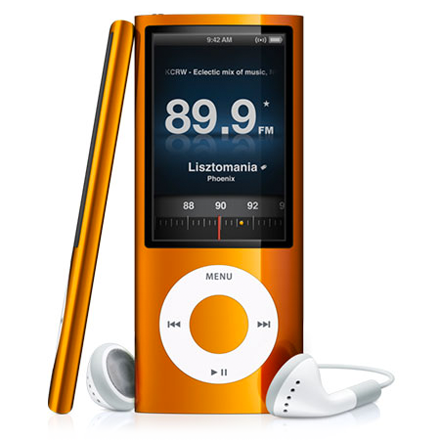
Apple iPod Nano – now with FM and Tagging. Is that good? 10/09/2009

Filed under: radio,technology — Nick Piggott @ 09:16
Just when you think there’s nothing interesting you can blog about, Apple come and chuck fresh meat to the wolves.
Of course, everyone’s excited about Apple including radio in one of their devices for the first time. That’s clearly good news. It would be amazing news if it was a DAB Radio in Europe, and an HD Radio in the States, but let’s work on that one. Baby steps.
Let’s assume that Apple don’t incorporate functionality into their devices unless they think users are going to go “wow – cool”. As Mark Ramsay says, Apple didn’t just throw an FM tuner in there; they “enhanced radio”, so it includes pause/rewind and tagging. Adding this kind of functionality costs real money (in material and engineering time), so we should be pleased that Apple see that as a worthwhile investment. Yes, Radio is still cool, and still valued even by the cool kids who buy Apple iPod Nanos. This is a “radio” that 15-24s will love to have.
James explains a bit about how the existing Apple iTunes Tagging works. It’s a system designed to do one very specific job, for one specific group of stations and listeners. It transmits Apple iTunes Catalogue IDs in spare RDS ODA (Data) groups, using a form of encryption (discuss…). The radio station incorporates the iTunes IDs into their FM RDS transmission, the iPod Nano receives/decodes this, and when you hit “Tag” it stores the ID/Artist/Title in memory. When you sync up your Nano with iTunes, iTunes converts that into proper store links, and offers you the downloads. It works. Listeners can tag songs on the radio, and buy them in iTunes. A similar service is also available on HD Radio, and was launched earlier, IIRC.
So what’s not to like. Isn’t this the perfect demonstration of innovative revenue generation in a digital media world?
Maybe, but I don’t think it was initially designed with the listener in mind. It looks like a system designed to turn radio listeners into Apple iTunes customers. There’s nothing wrong with that, incidentally. The rather depressed radio business got a big kick out of being able to announce a tie-up with Apple, who are highly regarded. There’s significant kudos is being allowed to play with the smartest boys on the block.
James has pointed out the weaknesses in the existing system. It doesn’t scale terribly well (although I believe either FM or HD have also started parallel transmission of Amazon IDs for their MP3 store?), and it only works for iTunes and material that’s in iTunes.
There another weakness in the system, in my opinion.
If you look at how the meta-data moves around, it goes in one direction only. From the radio station, via FM, the Nano, iTunes and to Apple. After the radio station has splurged the meta-data out on the broadcast platform, it has no control or visibility of it from that point onwards. There has to be a contractual relationship between Apple and each Radio Station for Apple to pass information about the songs sold back to the radio station. I have no idea how detailed that information is. Does it list every transaction, by every device, by time of day? Does it report transactions, or tagging events, or both? Or do they just get a $ total each month and a check for the affiliate fees?
Excluding the broadcaster from the process, and obfuscating the outcome, diminishes the value for radio. It turns us into an customer acquisition vehicle, without getting rich information on listener behaviour.
There’s also the small problem of ne’er do wells “stealing” the meta-data. Let’s assume that someone nefarious decides to strip that meta-data, and amend the affiliate ID to be their own. You might use an apparently legitimate streaming portal, or attractive device, and that money would go to the middle-man, not the radio station. The value of meta-data is increasing, and we should be more careful about whom we exchange it with. In my opinion, broadcasting meta-data risks destroying value. I do agree that meta-data should be open, but I generally think that you should know who you’re providing it to. (I’m going to blog about the side-effects of this shortly).
As you’d expect, I think the RadioTAG model is fairer. It keeps our meta-data relatively secure, whilst still allowing legitimate users (like listeners and Apple) to have access to all the information they need. It scales well, because it’s not transmitting vendor specific information over the air. The broadcaster can see who is requesting what meta-data when, and use that to track listener behaviour in real-time. And very importantly, it lets people tag *anything* interesting they hear on the radio, not just the songs.
I’m excited that Apple are into radio. I’m excited that the Nano is such a great little device. I’m excited for the prospects of Tagging on the Nano. I just want to make sure we make it great for listeners, as well as for radio stations and for Apple.
Apple iPod Nano with FM (C) 2009 Apple

Apple iPod Nano with FM (C) 2009 Apple

Just when you think there’s nothing interesting you can blog about, Apple come and chuck fresh meat to the wolves.

Of course, everyone’s excited about Apple including radio in one of their devices for the first time. That’s clearly good news. It would be amazing news if it was a DAB Radio in Europe, and an HD Radio in the States, but let’s work on that one. Baby steps.

Let’s assume that Apple don’t incorporate functionality into their devices unless they think users are going to go “wow – cool”. As Mark Ramsay says, Apple didn’t just throw an FM tuner in there; they “enhanced radio”, so it includes pause/rewind and tagging. Adding this kind of functionality costs real money (in material and engineering time), so we should be pleased that Apple see that as a worthwhile investment. Yes, Radio is still cool, and still valued even by the cool kids who buy Apple iPod Nanos. This is a “radio” that 15-24s will love to have.

James explains a bit about how the existing Apple iTunes Tagging works. It’s a system designed to do one very specific job, for one specific group of stations and listeners. It transmits Apple iTunes Catalogue IDs in spare RDS ODA (Data) groups, using a form of encryption (discuss…). The radio station incorporates the iTunes IDs into their FM RDS transmission, the iPod Nano receives/decodes this, and when you hit “Tag” it stores the ID/Artist/Title in memory. When you sync up your Nano with iTunes, iTunes converts that into proper store links, and offers you the downloads. It works. Listeners can tag songs on the radio, and buy them in iTunes. A similar service is also available on HD Radio, and was launched earlier, IIRC.

So what’s not to like. Isn’t this the perfect demonstration of innovative revenue generation in a digital media world?

Maybe, but I don’t think it was initially designed with the listener in mind. It looks like a system designed to turn radio listeners into Apple iTunes customers. There’s nothing wrong with that, incidentally. The rather depressed radio business got a big kick out of being able to announce a tie-up with Apple, who are highly regarded. There’s significant kudos is being allowed to play with the smartest boys on the block.

James has pointed out the weaknesses in the existing system. It doesn’t scale terribly well (although HD appear to be also transmitting different tagging information to support Microsoft’s new Zune HD), and it only works for iTunes and material that’s in iTunes.

There another weakness in the system, in my opinion.

If you look at how the meta-data moves around, it goes in one direction only. From the radio station, via FM, the Nano, iTunes and to Apple. After the radio station has splurged the meta-data out on the broadcast platform, it has no control or visibility of it from that point onwards. There has to be a contractual relationship between Apple and each Radio Station for Apple to pass information about the songs sold back to the radio station. I have no idea how detailed that information is. Does it list every transaction, by every device, by time of day? Does it report transactions, or tagging events, or both? Or do they just get a $ total each month and a cheque for the affiliate fees?

Excluding the broadcaster from the process, and obfuscating the outcome, diminishes the value for radio. It turns us into an customer acquisition vehicle, without getting rich information on listener behaviour.

There’s also the small problem of ne’er do wells “stealing” the meta-data. Let’s assume that someone nefarious decides to strip that meta-data, and amend the affiliate ID to be their own. You might use an apparently legitimate streaming portal, or attractive device, and that money would go to the middle-man, not the radio station. The value of meta-data is increasing, and we should be more careful about whom we exchange it with. In my opinion, broadcasting meta-data risks destroying value. I do agree that meta-data should be open, but I generally think that you should know who you’re providing it to. (I’m going to blog about the side-effects of this shortly).

As you’d expect, I think the RadioTAG model is fairer. It keeps our meta-data relatively secure, whilst still allowing legitimate users (like listeners and Apple) to have access to all the information they need. It scales well, because it’s not transmitting vendor specific information over the air. The broadcaster can see who is requesting what meta-data when, and use that to track listener behaviour in real-time. And very importantly, it lets people tag anything interesting they hear on the radio, not just the songs.

I’m excited that Apple are into radio. I’m excited that the Nano is such a great little device. I’m excited for the prospects of Tagging on the Nano. I just want to make sure we make it great for listeners, as well as for radio stations and for Apple.


Next Page »